
by Luca Fiore
“Please, mention Sergio Fregoso. It matters to me.” That is Jacopo Benassi’s only request, one he never misses the chance to repeat in every interview, always citing the photographer from La Spezia whom he regards as his mentor. “More than photography itself,” he explains, “he taught me how to look.” He recalls La Spezia in the 1980s, when he used to hang out at the Kronstadt squatted social center, and it was Fregoso who introduced him to amateur photography—but with a “much more intellectual perspective. He was the one who made me discover Ando Gilardi…”
On the website of the Sergio Fregoso Archive, a phrase stands out in black type on a white background, visually modest yet arresting: “I don’t want to shed the air of home, the smell of my city. Moment after moment, without pause, I want to contain it all on my film, which is my skin, my sensitive surface.” Looking at the photographs of this man, born in 1927 in La Spezia’s working-class Umberto I neighborhood, a founding member of the AV 70 Group—bringing the language of images into schools and the city’s outskirts—one encounters flat, color images, mostly of windows. Nothing could be further from Benassi’s poetics. And yet, in every interview, that plea resurfaces: “Please, mention him.”
Jacopo Benassi was also born in La Spezia, in 1970. Last year, the online magazine Artribune named him “Artist of the Year” (notably: artist, not photographer). Massimo Minini, the doyen of Italian gallerists, brought him in June to the epicenter of the contemporary art world: Art Basel, the most important fair on the planet. Not bad for someone with a turbulent punk, anarchist, and disobedient past. (He admits: “Today it almost makes me laugh to say I do counterculture. And yet, deep down, underground, my spirit still resists ignorance and banality.”)
I meet Benassi in a ground-floor room of the Palazzo Ducale in Genoa. There, in June, he had moved his studio, working thanks to a residency organized by Blu–Breeding and Learning Unit, made possible by ministry funds from Strategia Fotografia. It was during those days that he created the core of works concluding the exhibition Jacopo Benassi. Libero!, curated by Francesco Zanot, on view at Palazzo Ducale until September 14. Beforehand we meet at a bar. Black pants, black T-shirt. Plastic slides with white stripes. At his side is Khan, a lanky Berlin-based musician, half Turkish, half Finnish, wearing a shirt that reads “Beuys Beuys Beuys.” A double homage: to the German shaman-artist and to the unforgettable hit by Italy’s own Sabrina Salerno. That evening, one of the musical performances that have long been central to Benassi’s practice is scheduled.
He begins his story from the very start: squats, music, political activism. He draws, paints, photographs. He works as a mechanic. His friend Renzo “Benzo” Davetti, frontman of the punk band Fall Out, once told him: “You can make art even if you’re a factory worker.” In 1989, Kronstadt hosted an exhibition by the collective “Arterie barbare.” He was there too: “We were a bunch of misfits.” For the occasion he showed a one-and-a-half by two-meter painting depicting a Caravaggesque deposition of Christ pierced with giant forks: “Something deliberately blasphemous. Even though my devoutly Catholic mother took it and hung it in her bedroom.”
The first turning point—or one of the artist’s many fresh starts—came in 1996. That was the year of his coming out, when he publicly declared his homosexuality and discovered his “normal light,” the flash, which became his signature. “Maybe it was coincidence, but it happened in the same weeks, and it was the end of a repressed nightmare. One day I was at a friend’s house and I realized this light was mine. From that moment, I couldn’t look at my images without flash anymore. It’s a huge renunciation of photography, really, because it means giving up on beautiful images. You can’t photograph the sky anymore, you can’t capture crowded scenes or the people in front will be burnt out and harsh shadows will cover whoever’s behind. The flash flattens everything.” With digital, for purely chromatic reasons, his images became exclusively black and white. “With color I couldn’t achieve the flattening effect I was looking for.”
His skewed, raw images—mostly of bodies—brought him to Milan in 2002, where he worked extensively in editorial photography. He published in GQ and Rolling Stone. But after four years, something felt wrong: “My photographs were becoming ‘beautiful.’ I was looking for the perfect frame. I was using expensive lenses. I was starting to give up the flash. Some of my images were beginning to look like Gabriele Basilico’s. I was losing myself. One day they told me to take my portfolio to Vogue. But I never went. Instead, I returned to La Spezia and opened a club with some friends.”
That club was Btomic, punk at its core. Experimental. A place to play music, drink, print T-shirts and fanzines. Peeling walls, a bohemian atmosphere. It was there that Benassi first took the stage. He played music, but it was the camera that dictated the dramaturgy. The performance was made to be photographed, yet it stood on its own as an event. The artist slapped the audience with his flash and asked them to do the same. “I’m not an actor, nor a musician, nor a dancer. I started because I felt I had to. There’s no script, it’s almost all improvisation. I think a bit about Fluxus, about the breaking of the score that Giuseppe Chiari talked about. Only later do I decide if and how to use the images created in those moments.”
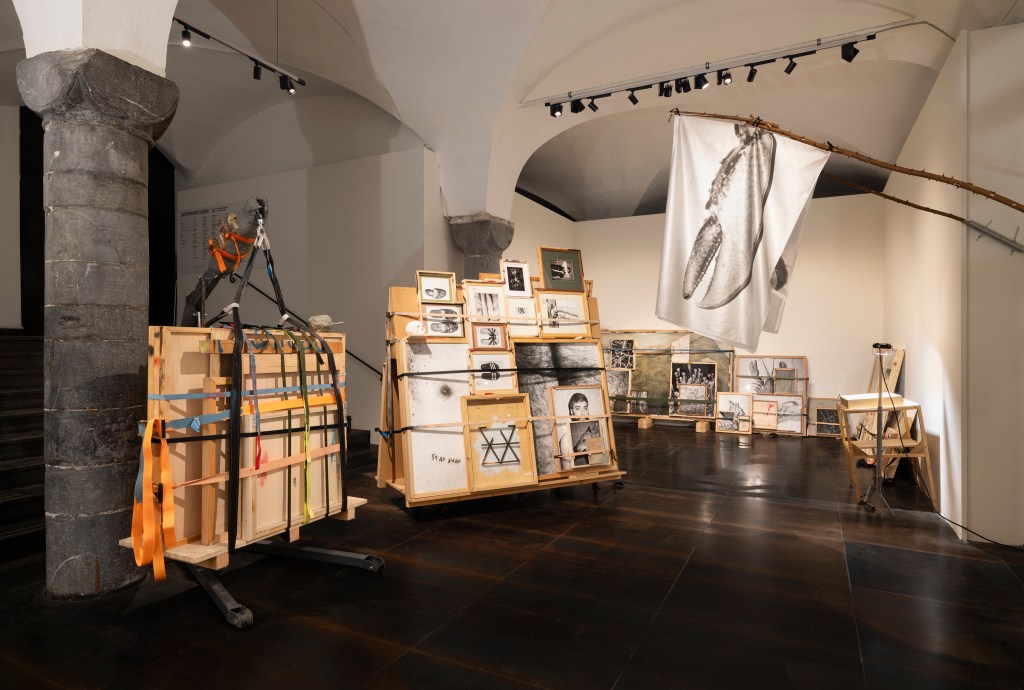
But after 2020, Benassi’s practice took an irreversible turn, leading him to where he is now. “At the Leica space in Milan, for the first time, I cut through the glass. I stepped outside of photography—meaning that temple of amateur photography gave me the chance to enter a contemporary world. It was almost a painterly gesture, almost a tribute to Fontana, to look inside the emerging image.” From there, the momentum kept building: Museo Pecci in Prato, Fondazione Carispezia, GAM in Turin, Galleria Minini in Milan, Mai36 Gallery in Zurich. Benassi expanded his language: writing on walls, burning frames, strapping photos together with industrial belts, collecting objects, making sculptures. An aesthetic that at times recalls the “DIY” ethos of Swiss artist Thomas Hirschhorn, who made sculptures out of brown packing tape. “I’ve realized I’m an imperfect person, so I work on imperfection. In photography, with brushes, in everything—even in performance I let myself be who I really am. I don’t strive for perfection, because I wouldn’t be able to. I’ve perfected myself to the point of now being number one at making mistakes.”
It was during this period that his mother passed away. Benassi had to clear out his parents’ home, sorting through boxes and revisiting his childhood—the good and the bad. He came across his old school reports: “They said I was intelligent but got distracted easily. And that’s who I still am today. I lose focus immediately. It’s part of my character. My imperfection.” In his parents’ bedroom he found his youthful painting of the Deposition. Taking it down, he saw the shadow the canvas had left on the wall, like a shroud imprint. He photographed it. That image of the dirty wall was then assembled to almost entirely cover the “forked Christ” painting, alongside a smaller photo of the nightstand where his father slept, marked with cigarette burns from smokes left lit before falling asleep. A sacred work, shown this year at the Museo Diocesano in Milan as a counterpoint to a Deposition by Tintoretto. A meditation on love, intimacy, mourning, memory. Because, as the band Baustelle sings: “Il tempo ci sfugge / Ma il segno del tempo rimane” (Time escapes us / But the mark of time remains).
The Genoa exhibition is full of photographs of butterflies. A cow’s portrait. A lobster. A monkey. Skulls. Flip-flops. Countless flip-flops. One afternoon in his temporary Palazzo Ducale studio, Benassi receives a package containing a pair of Playstation-branded slides. He reacts as if he had received a priceless gift. I ask him what they mean to him: “They’re my obsession. I realized I was gay when I first saw them as a child, and for years I avoided wearing them—I even showered in socks—out of fear of being exposed. They were so intimate, tied to nakedness, that showing them terrified me. Now I’ve metabolized them, and I integrate them into my works as my most intimate portraits, transforming that fear into art.”
The exhibition unfolds in clusters of framed photographs, where subjects dialogue by shape or content, forming what one might call “visual rhymes.” But what strikes most in Genoa is the space taken by painting, to which Benassi has returned. “I started painting like a photojournalist: fast, imperfect, because I don’t have the patience for thorough study. It allowed me to break free from traditional photography. I paint to enjoy myself deeply, creating works about my city where the human figure no longer appears, leaving room for nature to reclaim space.” Most works are displayed resting on the floor, as if the visitor had arrived the day before the opening. Almost an invitation to share in the provisional condition that pervades Benassi’s practice.
Another recurring theme is rose thorns. Photographed, but also sculpted, coexisting with the images. Benassi explains: “Today the thorns are my defense, a wall I raise, a real political barricade that protects me, though it forces me to be careful not to hurt myself. In my work, they symbolize roses that refuse to bloom, flowers striking in protest against wars, a reflection of a world on fire. They are the deep portrait of who I am today, a mix of hardness and joy.”
This, perhaps, is the key to reading Benassi’s entire body of work: the pairing of opposites. Severity/humor is just one of its many forms. Behind the visual noise—atonal, like dodecaphony (badly made frames, tape, casual brushstrokes, mounds of clay)—lurks a strong classical rigor. A very punk approach: in late-1970s England, the Sex Pistols were nothing but the flip side of Queen Elizabeth. Aesthetically, Sid Vicious and company wouldn’t have existed without the monarchy’s flawless image. And probably, the reverse was also true.
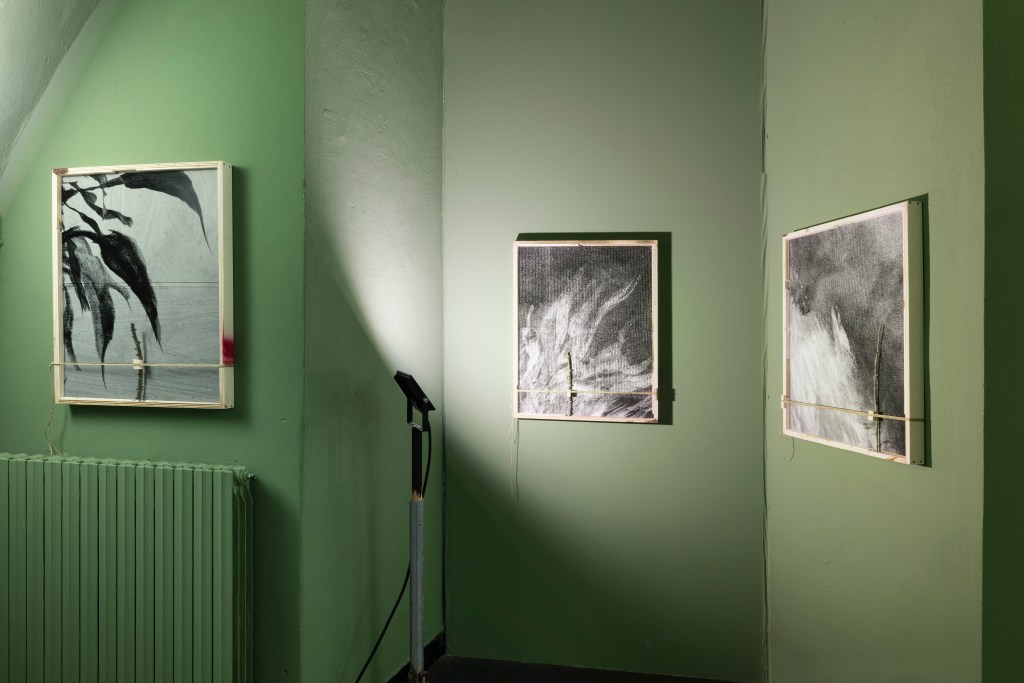
The exhibition route ends in a tunnel-like labyrinth filled with sculptures—sometimes obscenely self-mocking—objects, and writings that reflect the unsystematic, chaotic work of the Genoa residency. Emerging from the tunnel, one finds oneself in the museum bathrooms, where Benassi exhibits works made for Villa Croce, the city’s ill-fated contemporary art museum. These are photographs of his paintings depicting cut flowers, battered leaves, skies glimpsed from the villa’s garden. “I find it ironic and liberating to paint skies and then photograph them with a flash, prompting reflection on what lies behind an image. Today I feel free from any framework photography imposes, and this painting is a continuous evolution of my language.”
Benassi is the classic case who drives photography purists mad. It’s the eternal rivalry dating back to the early 20th century: pictorialists, who wink at the figurative arts as if photography weren’t art enough, versus modernists, who insist the medium can be art in its own right—though condemning themselves to isolation and marginality. Benassi has sided with the former. But, like all sensible people, he knows rigid frameworks kill intelligence. And outside Palazzo Ducale, he has sprayed a phrase of delicious ambiguity in red paint: “Benassi against the condemnation of photography.”


 Luca Fiore | Writing on Contemporary Art and Photography