by Luca Fiore
Before taking my leave, after spending a few hours in his apartment in Adams Morgan, one of Washington DC’s well-heeled neighborhoods, I ask if he can recommend any critical writing about his work — something useful for putting together this article. He looks at me and smiles: “Read Moby Dick and substitute my name for the white whale.” John Gossage is just like that: sharp, ironic, and self-mocking. By his own admission, when tackling a subject as demanding as art, he prefers to lighten the conversation with a well-placed joke.
Born 78 years ago on Staten Island, New York, Gossage is a man brimming with energy. He is like a sprite: short, excitable, erratic. Despite the scarcity of literature devoted to him, he is one of the most respected photographers in America — shown in the most important museums, present in the most prestigious collections, and admired for the enigmatic quality of his projects. Some go so far as to use the word “legendary,” especially those who regard him as one of the supreme figures in photography publishing. And yet, if you look carefully enough, two of the most brilliant pens ever to write about photography have written about him: his colleagues and friends Robert Adams and Lewis Baltz.
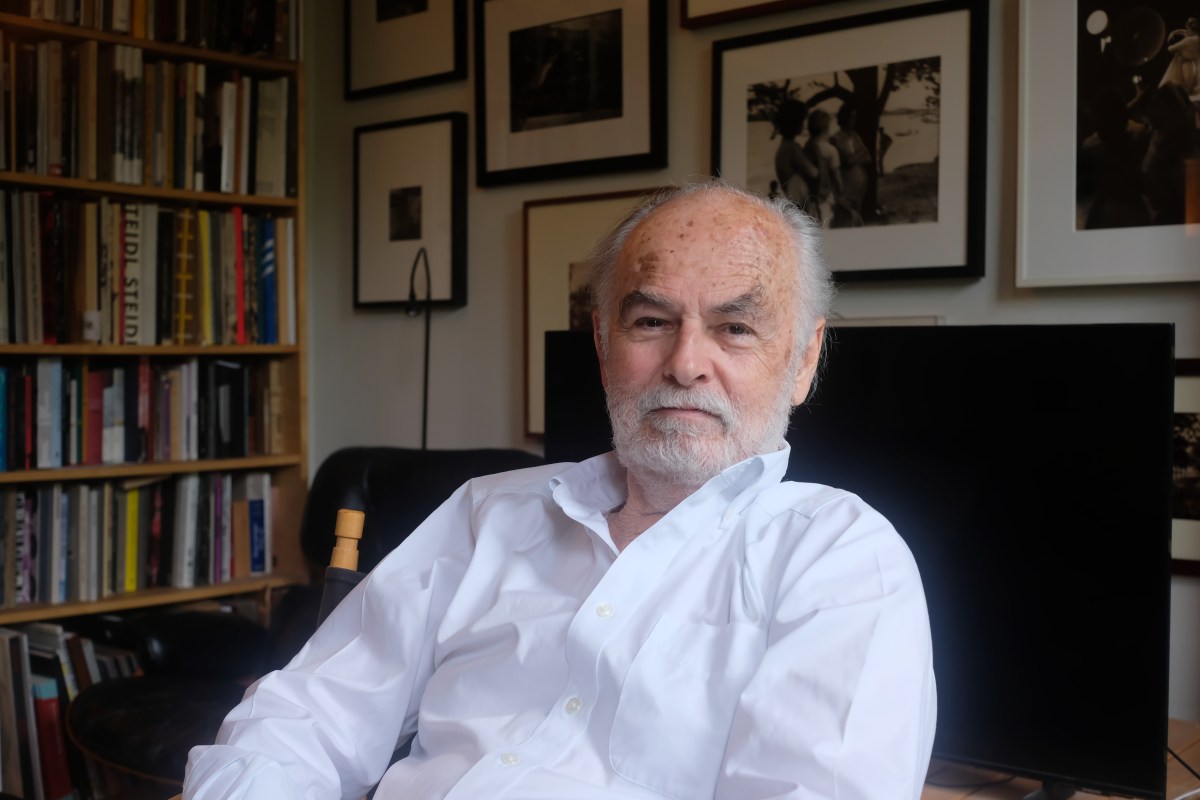
In his apartment he keeps what is considered the finest private collection of photobooks in America. “The only one who probably has a better one is Martin Parr, in Bristol.” When the conversation turns to Italian photography and its masters — he is a close friend of Guido Guidi, even though neither of them can speak the other’s language — he leaps up and pulls from the shelves an almost pristine copy of Viaggio in Italia, the now near-unobtainable watershed book conceived by Luigi Ghirri, which this year marks the 40th anniversary of its publication.
John Gossage is a treasury of anecdotes. He has known in person nearly all the great figures of photography from the second half of the twentieth century. He recounts the time Diane Arbus asked to take his portrait, and he agreed on the condition that he could take one of her in return. Or the time he bought a Leica from W. Eugene Smith, the patron saint of photojournalists. Or the story of how, barely more than an adolescent, he knocked on the door of Magnum Photos’ New York office hoping to meet Henri Cartier-Bresson and persuade him to reveal the secrets of the trade. He speaks of his teachers: Lisette Model — with whom Diane Arbus had also studied — Alexey Brodovitch, the brilliant art director of Harper’s Bazaar, and Bruce Davidson, another legendary figure of photojournalism.
“I started working at fourteen as a sports photographer for a local paper. I’m basically a dropout,” Gossage says. “I have a learning disability, which means I really can’t write, or I do so only with great difficulty. So instead of going to school, I used to spend my afternoons in a record shop beneath the subway at Times Square. My mother worked, and I was raised by wolves. At some point I enrolled in the evening photography courses at the New School for Social Research, where Lisette Model was teaching. She noticed I wasn’t the eighteen years old required to attend, but she turned a blind eye.” They were wonderful classes, he recalls. The great photographer was someone who, rather than teaching you how to do things, showed you how to learn: “She encouraged you to follow the lesson of the best.” One day, the young boy asked her who she thought was the greatest photographer in history. “Darling, there is a gentleman by the name of Eugène Atget. But you’re not ready to understand him yet.” The next day Gossage went to a bookshop on Lexington and asked whether they had anything published by the Parisian photographer discovered by Berenice Abbott. They went down to the basement and found one of the many unsold copies of his only monograph, published in 1930 by E. Weyhe. “I buy it. I open it and understand nothing. Only years later did I begin to grasp it.” Today, two vintage prints by Atget hang in Gossage’s living room, along with one of the portraits Abbott made of him in Paris. “He’s there looking at me every day, reminding me to stay humble.” The French photographer’s archive is now held at MoMA, which, on the same wall in the first room of its permanent collection, displays six of the artist’s albumen prints alongside two masterworks by Paul Cézanne.
The photographer’s singular biography also includes a detour into rock music. In his studio, among boxes of negatives and contact sheets, sits his 1954 Fender Telecaster, which he learned to play from Roy Buchanan and Danny Gatton. Torn between music and photography, in 1968 he chose the latter after two weeks on tour with Eric Clapton’s Cream: “I realized I didn’t have the constitution to do drugs the way they did…” A few years later, through his friendship with Lewis Baltz, he was taken on by the prestigious stable of Leo Castelli, the king of New York gallerists, who had made his fortune by bringing the great names of Pop Art to the world’s attention. The partnership lasted from 1975 to 1990, when the Trieste-born dealer retired. “Leo called and asked me which other gallery I’d like to work with. A phone call from him, back then, would have opened any door. I told him it wasn’t necessary, because I wanted to devote myself to my books. I had understood that artist’s books are the major league of photography. That’s what I wanted to do.”
A few years earlier, in 1985, his first monograph had been published by Aperture: The Pond, considered his masterpiece. It is a sequence of black-and-white images made near a pond, in an area of untended woodland on the edge of a city. “It is a sly and subversive book,” writes Toby Jurovics in the introduction to the latest edition: “When first published in 1985, it appeared to be somewhat chaotic, a little jarring in its transition from one image to the next. Every now and then we were left to wonder, ‘Why did he make this picture?'” Indeed, what strikes you in so many of these pictures is the apparent absence of a subject. Jurovics continues: “This confusion seemed to undermine our notion of photography’s supposed forte — its capacity for straightforward description and transparent meaning. Yet as we turned from page to page, before we realized what was happening, John Gossage convinced us to join him on a walk. Had he first told us where we were headed, we might have declined, but it was too late to turn back.” The point, for the artist, is that in literature landscape inevitably becomes setting, the backdrop to a story. Verbal language struggles with the description of the natural element. Photography is different: landscape can become the principal subject. The succession of images is necessary and corresponds to the path the author wishes us to follow. But there is more. The challenge is not merely to simulate a walk. What the true stakes are, Robert Adams explains in his review of the volume for Creative Camera: “Irony, defined as unrecognized incongruity, takes many forms as a subject for art. John Gossage has in his previous work been alert to several kinds, among them the sort of irony that interested Melville – the disproportion, unacknowledged, of the individual to the world as a whole. One of Gossage’s funnier pictures records, for instance, an ant making its way up a utility pole.” In this book, Adams explains, “though it implicitly acknowledges such disproportions (and implies they offer consolation rather than humiliation), [it] is fundamentally not about ironies of a lesser sort. Despite his echo of Thoreau (author of Walden, or Life in the Woods – ed.), which might seem to promise a didactic pounding, Gossage does not use his survey of wood around a lake to stress an indictment; the off-road landscape through which he leads us is a mixture of the natural one and our junk, but his focus is not so much on the grotesqueries of the collage as on the reassurances of nature’s simplicities.”
If you ask Gossage today what he looks for in a photograph, he replies: “I feel the need to know more. I want to see a new perspective on things. Something never considered before. Unexpected. Sometimes we find ourselves before something that, in itself, shouldn’t work. And yet it does.” But how do we recognize that a photograph is not merely a document but something more? “It takes only a few moments to look at an image. And yet there are photographs that go on speaking to you without ever growing tiresome. That is the difference between an ordinary photograph and a work of art. The latter has the power to give you the conviction that life has meaning.” And what makes the language of photography unique? “It is a fairly limited medium, but one with enormous depth. Cinema manages to be more faithful to what it reproduces. But what photography does — stopping things, pulling them out of the flow of time — makes it a unique instrument, because stillness is something fascinating and difficult to experience directly in life. It fixes things, removing them from time, so that they become memory. Within the frame, it is as though we were seizing a possibility of meaning that is communicable, in all its complexity, only in that way. But this also means that photography opens up the possibility that metaphor, in the world, truly exists.”
It would be impossible to list all the many volumes Gossage has produced — in recent decades he has worked with the Göttingen publisher and master printer Gerhard Steidl. What can be said is that the constant running through the artist’s work, who only in recent years has begun working with colour, is a sense of steady enigmaticism that he manages to imprint upon his images. Something that sets him apart from American photography and draws him closer, in certain respects, to the work of the German photographer Michael Schmidt and his friend Guido Guidi. Lewis Baltz, in the pages of Aperture magazine, once commented on an image Gossage took in Seattle in 1979. It shows an ordinary windowsill, framed so that you can simultaneously see part of the window, the wall of the building, and the street below: “Like all photographers skilled in the documentary style, he too understands that his best opportunities lie in drawing an epiphany from the neglected and disregarded things of the world, using the most economical means available — that is, by fully exploiting what is most intrinsic to still photography. At times he achieves this with an ease and a literalness that verges on the perverse, because what could be more intrinsic to photography than stillness itself?” But Baltz is not referring to the category of the “decisive moment”: “His concern turns toward a more radical understatement, arresting less dynamic, even static situations, to invite a more ironic reading of the relationship between photography and what is photographed. Gossage’s view is that he aspires to introduce into his work a dimension that might be called mythic. (…) The author of a contemporary mythology must operate in circumstances very different from those of his predecessors: rather than manipulating a shared system of belief, he must acknowledge that all such systems are in ruins and that nothing is entirely credible. A contemporary myth should be an inverted myth — one that promotes skepticism rather than faith and substitutes irony for credulity.”
On closer inspection, we are confronted with a skepticism and an irony that are more procedural than substantive. Gossage’s photography does not appear to relinquish a claim to knowledge of the world, or to the recognition of meaning within it. Rather, his subversive attitude is directed at received wisdom, at the laziness of the gaze, at the complacency that fails to perceive the metaphor that the world itself constitutes. That myth, or that epiphany, which light manages to trap in the silver salts of photographic film in so mysterious a fashion.
 Luca Fiore | Writing on Contemporary Art and Photography