by Luca Fiore
Kristine Potter is one of the new voices in American photography. Her dense and elegant black and white images, while respecting the formal canons of tradition, are windows that open up glimpses into certain stereotypes on which, until today, US society has perched.
Born in Dallas in 1977 into a military family (her father and grandfather were both army officers), she grew up in Warner Robins, a small town in central Georgia.
His mentor was Mark Steinmetz, a silent and highly refined photographer, a great heir to the American black and white tradition, author of South Trilogy, three volumes considered a milestone in photography publishing of the last twenty years.
Potter’s first major work is entitled The Gray Line, dedicated to the cadets of West Point, America’s most prestigious military academy. It is a reflection on the construction of masculinity and its connection to an idea of institutionalised management of violence.

His cadets, whether in full uniform or in battle dress, are ordinary young men, with pensive gazes, over whose fate lies the shadow of death, suffered and procured.
“After that project,” explains the artist, “I found myself helping to order the family archive, which contained some photos inherited from my great-grandparents. They called themselves ‘sharpshooters’, they were actually Wild West artists. They toured with Buffalo Bill: it was the first form of entertainment related to that imagery. There I thought that the cowboy was another archetype of American masculinity that I could work on’.
Thus was born the idea for the project that was to become Manifest, the book published by the Californian publisher TBW Books, which owes its title to the expression ‘Manifest Destiny’, summarising the 19th century colonists’ belief that the conquest of all North American territory was God’s will.
“Through fortuitous circumstances I ended up on the western slope of Colorado, a remote and sparsely populated area. I stayed, at first, a whole summer. I wanted to photograph people, but there were so few people around that at first I spent entire days without meeting anyone. So I also started to take landscape images, which I had never done before”.
Potter knows that, in the United States, the history of landscape photography was made in the West. And, in the early days, the images of authors such as Carleton Watkins had fed the rhetoric of ‘Manifest Destiny’, which had led to the conquest of those regions at the expense of the natives. During the five years she returned west, Potter continued to make portraits, particularly of people who had moved there for an idea, as if to revisit the ancient dream of the settlers.
“I started to ask myself what meaning that rhetoric can have today and whether all the violence it produced really realised that dream. And the answer is no. They are such inhospitable places that you can barely live there’.
The image of the men photographed does not correspond to the stereotype of the cowboy in John Wayne’s films: ‘Some were really ranchers, others were farmers, others wandered around looking for odd jobs. But what is certain is that none of them felt like heroes’. From the point of view of rendering nature, the photographer distances herself from the tradition that had celebrated the miraculous glory of the vast spaces of the West. The horizon is almost never there: rocks dominate, the land is barren and the vegetation is all a tangle of shrubs.
The strange sequence of landscapes and portraits, some spontaneous others posed, was noticed by the great British photographer Paul Graham, who decided to include Kristine Potter’s work in the 2021 exhibition at the International Center of Photography in New York, entitled ‘But Still, It Turns’. The exhibition brings together a number of authors representing so-called ‘post-documentary photography’. That practice, that is to say, which uses documentary tools and style (the one that descends from Walker Evans) without the concern of returning a faithful or objective image of what they record, but with the ambition of saying more than what is seen in their images. A mix of poetry and document. Invention and facts. A genre that could perhaps be compared to non-fiction in literature: that which is done by writing about reality, but whose result goes beyond mere reportage.
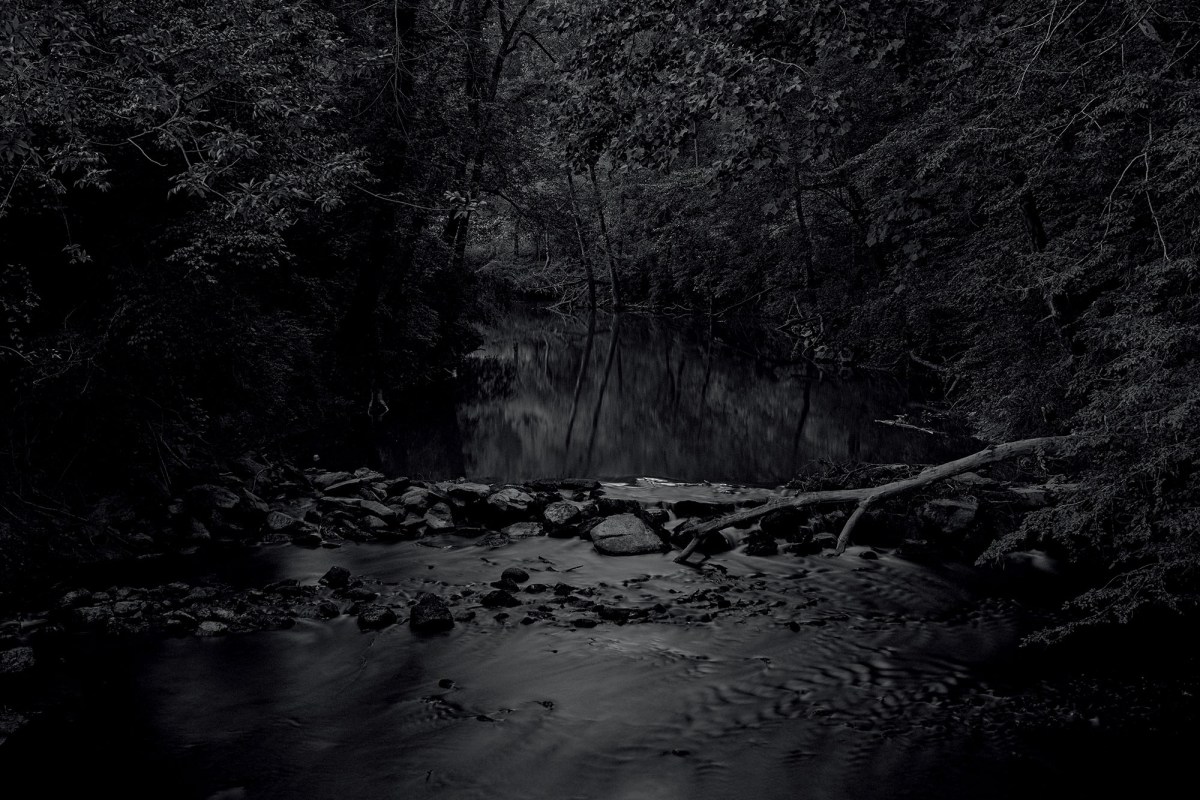
Potter’s latest project, Dark Waters, also belongs to this genre of photography. First presented at the Swiss Image Vevey festival, where it won the jury prize, then at Micamera in Milan, it has now taken the final form of a book, published by Aperture, the most authoritative photography publisher in the United States.
“I grew up in the south, in Georgia. Not far from the town where I lived, there is a creek called Murder Creek. I must have walked past it hundreds of times without paying attention. But once I asked myself: what the hell kind of name is that? Why is it called that? Then I wondered if there were other places with the same name. And, with map in hand, I realised that not only were there others, but the US is littered with terrifying names: Dead Man River, Spring Rape, Bloody Fork, Blood Creek…”.
This observation is intertwined with the observation of the existence of the all-American tradition of murder ballads: songs that recount bloody episodes, in which, almost always, it is a man who kills a woman and abandons her in a river or lake. These songs are so deeply rooted in American folk that some of them have become true standards: Pretty Polly was recorded by Bob Dylan, Knoxville Girl by Nick Cave, Down in the Willow Garden by The Chieftains and Bon Iver.
Potter, for instance, went to the historical sites of the death and burial of Naomi Wise, the young orphan girl protagonist of the song Omie Wise, who was killed in the waters of a North Carolina creek in 1808. In this work, too, the artist alternates between landscapes and portraits. The men are shot outdoors, while the women are immortalised in the studio, against a black background, almost impersonating the heroines of murder ballads. Reality and fiction interact with the lyrics of the songs to create a deliberately disturbing tale. Violence and death are only evoked, yet they form the searing core of the work.
“I have wondered if the history of violence, with which the southern United States in particular is steeped, also lives in the landscape. Or at least it affects us when we move. I am interested in the fact that all the stories we tell about ourselves, I am also thinking of the southern gothic tradition – William Faulkner, Carson McCullers or Flannery O’Connor – are often based on violence. And, for women in particular, this lives in our psyche: if I cross a car park at night to get my car, I clutch my keys in my hand like a weapon, because I know something could happen to me’.
If for the landscape of the west, the artist had tried to render the sense of disorientation of the ‘modern cowboys’, the challenge in the south is very different. “In Colorado, there is so much light that even the shadows are bright. In Georgia, however, it is the exact opposite. Everything is dark, vital, full of energy. The vegetation is thick. And the darkness is what interested me. I wanted to render the echo I perceived. Which is perhaps the echo of the much violence our land has witnessed’.
The technical choices are also dictated by this research: whereas for Manifest, Potter had used a film view camera, for Dark Waters she chose the digital medium format, which allows, thanks to the greater sensitivity of the digital sensor, to capture the depth of field with shorter exposures, in order to better fix the details of the dimly lit scene.
But the search for detail is functional to the psychological rendering of the scene. The objective is not so much the documentation of real places or situations – the artist says that 80 per cent of the portraits are staged – nor even the literal representation of the stories of the murder ballads.
“For me, those songs are examples of much of our contemporary cultural storytelling – meaning entertainment that revolves around the diminishment of women. My work often employs specific examples but my hope is that they are understood to represent circumstances more generally. The more ambiguous imagery in the work is my way of asking questions about what is reality and what is in my mind – and by extension – what is informed by this long history of storytelling.”


 Luca Fiore | Writing on Contemporary Art and Photography